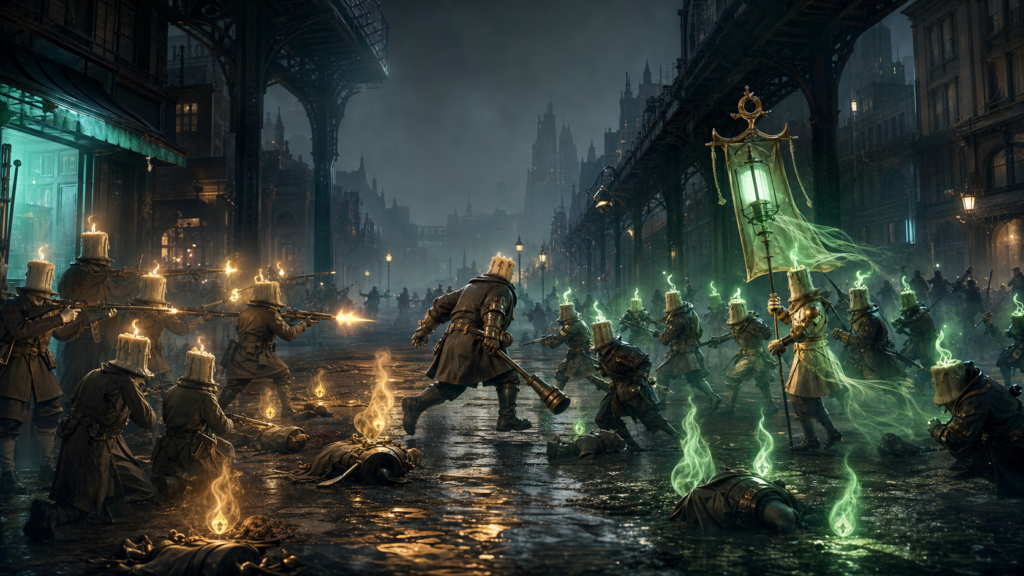
Deadlock Creeps & Troopers Guide: Waves, Souls & Denies
A current lane guide to ranged, Medic, melee, and Rift Troopers, plus soul confirms, denies, wave control, and rotation timing.
Control the four bodies, secure the orbs, then spend the window you created.
Updated July 21, 2026: Deadlock’s lane creeps are called Troopers in current game data. A normal wave contains four Troopers. Early waves use three ranged Troopers and one Medic; from 5:00, the current standard composition uses two ranged Troopers, one melee Trooper, and one Medic. The melee unit is the toughest normal lane body in the current asset data, with 400 base health and 80 melee damage.
Players still search for Deadlock creeps, minions, melee creeps, and lane creeps, but they are talking about this Trooper system. Learning it is the fastest route to better souls, safer lane control, and cleaner rotations. For the broader objective order, keep the Deadlock map guide open beside this one.
Deadlock Troopers At A Glance
| Unit | Current base health | Current damage | Main lane job |
|---|---|---|---|
| Ranged Trooper | 300 | 36 bullet damage; 50 melee damage | Regular ranged lane pressure and the most common early-wave body. |
| Medic Trooper | 350 | 36 bullet damage; 25 melee damage | Provides the wave’s healing presence and drops a healing pack for the side that kills it. |
| Melee Trooper | 400 | 80 melee damage; current weapon field is 61.8 bullet damage | Tougher close pressure added to normal waves from 5:00. |
| Rift Trooper | Special objective unit | Scales with the Unstable Rift wave | Pressures a chosen lane after a Rift capture and awards no souls. |
The values above come from current parsed game assets and can change in a hotfix. They describe base unit records, not every modifier active later in a match. The trooper_necro unit currently shares the melee Trooper’s 400 health, 61.8 weapon field, and 80 melee damage, but it belongs to special summon behavior rather than the ordinary post-5:00 lane lineup.
Deadlock Wave Composition And Timing
| Window | Current normal wave | What changes |
|---|---|---|
| Opening wave | 3 ranged + 1 Medic | The first wave travels more slowly on its vessel, giving players time to reach the lane. |
| Before 5:00 | 3 ranged + 1 Medic | Four bodies, with ranged pressure and a heal-focused Medic. |
| From 5:00 | 2 ranged + 1 melee + 1 Medic | The tougher melee Trooper replaces one ranged Trooper. |
| After defeating a base Guardian pair | Boosted reinforcement wave | The winning team gains immediate lane pressure to convert the structure advantage. |
| After an Unstable Rift capture | Rift Troopers join a selected lane | They create temporary objective pressure but do not award souls. |
The practical lesson is simple: count four normal bodies before leaving a wave. After 5:00, budget more time and ammunition for the melee Trooper. A rotation made after only killing the easiest ranged bodies can leave the toughest unit holding the lane in place.
How Souls, Confirms, And Denies Work
Troopers are the lane’s repeatable economy. When a Trooper dies, its soul value is not safely yours until the confirm-and-deny interaction resolves. Shoot the friendly-colored flying orb to confirm the available orb share; shoot an enemy-colored orb to deny that share from the opposing team. A missed orb can turn a correct health last hit into an incomplete economic exchange.
| Action | What it accomplishes | Common error |
|---|---|---|
| Last-hit the Trooper | Triggers the unit’s death and soul interaction | Spending the whole magazine early and having no accurate shot ready. |
| Confirm the orb | Secures the deniable flying-orb portion for your side | Looking at the enemy hero before the orb resolves. |
| Deny the enemy orb | Removes the enemy’s deniable share and awards the deny according to current rules | Standing in open sight for a low-probability deny. |
| Share lane proximity | Lets nearby allies participate in the lane economy under the current team rules | Assuming every player arrangement or patch uses an old split formula. |
Valve changed the deniable flying-orb share from 40% to 50% on June 30, 2026. The same update rescaled a Trooper’s bounty from 116 + 1.16 per minute to 100 + 2 per minute. That makes old guides with the 40% figure stale. Treat every soul breakdown as patch-dependent and verify current numbers after a major economy update.
Why The Medic Trooper Matters
The Medic is not just another 350-health target. Its heal changes how long a wave can hold space, and the side that kills it can use the dropped healing pack. Valve’s May 22 update increased the Medic Trooper heal duration from two seconds to four seconds, made additional heals add duration, and raised the heal from 12% to 13% of missing health.
- When trading: know whether the enemy Medic is about to sustain the units or player you are pressuring.
- When clearing: secure the Medic before leaving if the healing pack will stabilize your next action.
- When freezing: killing the Medic too early can change the durability and position of the remaining wave.
- When contesting: do not walk through obvious enemy fire merely because a healing pack exists.
How To Last-Hit And Deny More Reliably
- Read several health bars at once. Choose the next two likely deaths before the first one happens.
- Stop firing before the last hit. Preserve an accurate bullet and avoid entering a reload at the confirm window.
- Use cover for the orb angle. A confirm is valuable; losing half your health for it can erase the gain.
- Prioritize guaranteed confirms. Attempt the deny when your own orb and position are already secure.
- Use melee deliberately. A close secure can reduce the opponent’s reaction window, but stepping forward advertises the attempt.
- Track the Medic and melee body after 5:00. Their health and position change the rhythm of the wave.
Accuracy settings matter because the lane asks for repeated small targets under pressure. The Deadlock crosshair generator can make the reticle readable without covering the orb, while the sensitivity converter helps preserve familiar aim across games.
Deadlock Wave Management
| Lane state | How to create it | Why use it | Main risk |
|---|---|---|---|
| Freeze | Last-hit late and keep the surviving enemy wave near a safer position | Farm with less exposure and make the opponent walk forward | Too many survivors can crash and cost confirms. |
| Slow push | Build a small allied unit advantage without instantly clearing everything | Create a larger future wave that occupies the enemy | The setup is visible and can give the enemy time to rotate. |
| Fast shove | Clear the full wave quickly, including the post-5:00 melee body | Buy a short window to shop, farm nearby, or move first | Leaving before the wave reaches its destination can waste the pressure. |
| Crash | Escort the wave into the enemy structure | Force the opponent to collect under pressure and create objective damage | Overstaying past the crash invites a rotation or zipline return. |
A rotation is funded by the wave, not separate from it. The clean sequence is usually: clear or shape the wave, confirm the important souls, check the minimap, then move through the shortest safe route. The beginner guide explains how those windows connect to camps, shops, structures, and objectives.
Rift Troopers Are Not Normal Creeps
The Unstable Rift can send a pressure wave down a chosen lane. Valve’s June 30 update set the base at five Rift Troopers with up to 12 trailing units, gave them 100% increased health and damage, and specified that they award no souls. The July 9 update added scaling Spirit Resistance of 30%, 35%, 40%, or 45%, added 25% Melee Resistance, staggered their spawn interval, and increased the maximum comeback count from 12 to 14.
| Rift Trooper property | Current official value or rule |
|---|---|
| Base wave | 5 Rift Troopers |
| Trailing units | Up to 12 in the June 30 rules; comeback maximum increased to 14 on July 9 |
| Health and damage | 100% increased in the June 30 update |
| Soul reward | No souls |
| Spirit Resistance | 30% / 35% / 40% / 45% scaling in the July 9 update |
| Melee Resistance | 25% in the July 9 update |
Do not evaluate a Rift wave like a farm delivery. Its value is forced attention and structure pressure. Clear it because of what it threatens, then decide whether your team gained enough space elsewhere. See the Deadlock Soul Urn guide for the other major cross-map objective and how its reward differs.
Common Deadlock Trooper Mistakes
- Leaving a wave after three bodies and forgetting the fourth Trooper.
- Using an outdated guide that still says the flying-orb share is 40%.
- Starting a reload immediately before two low-health Troopers die.
- Fighting for a deny while a guaranteed friendly confirm disappears.
- Shoving automatically when a safer freeze would deny the opponent farm.
- Rotating before the wave is controlled, then losing more souls than the move earns.
- Treating Rift Troopers as normal soul-bearing lane units.
Deadlock Creeps And Troopers FAQ
What are creeps called in Deadlock?
They are called Troopers in current game data and patch notes. Players also use creeps, minions, lane creeps, or melee creeps as familiar genre terms.
How many Troopers are in a Deadlock wave?
A normal wave currently has four Troopers. Before 5:00 it uses three ranged Troopers and one Medic. From 5:00 it uses two ranged Troopers, one melee Trooper, and one Medic.
What is a Deadlock melee creep?
The melee Trooper is the tougher close-range lane unit added to normal waves from 5:00. Current parsed game data lists 400 base health and 80 melee damage.
How much is a Trooper worth?
Valve rescaled the current bounty formula to 100 plus 2 per minute on June 30, 2026, and set the deniable flying-orb share to 50%. Economy rules can change, so recheck the latest notes before using the formula in a calculator.
Do Rift Troopers give souls?
No. Valve’s June 30 update says Rift Troopers award no souls. They are an objective-pressure unit, not a normal farm wave.
Should I always push the lane?
No. Freeze when safety or denial matters, slow push when you want a future pressure wave, and fast shove when you have a specific shop, camp, rotation, or objective window.
Sources And Methodology
Normal Trooper health, weapon, melee, and movement fields were checked on July 21, 2026 through the independent Deadlock API NPC-unit asset response, which parses current game data. Normal wave composition and lane-state descriptions were cross-checked against the current Deadlock.io lanes and Troopers reference.
Medic healing changes come from Valve’s May 22 update. The bounty formula, 50% flying-orb share, and initial Rift Trooper rules come from Valve’s June 30, 2026 update. Rift resistances, spawn staggering, and comeback maximum come from Valve’s July 9, 2026 update. Deadlock remains in active development, so exact values and timing should be rechecked after patches.
More Deadlock guides
Move from the fundamentals into heroes, items, builds, and current match data.