
Deadlock Map Guide (2026): Lanes, Objectives, Urn & Rift
Learn the current three-lane Deadlock map, structure order, Soul Urn, Unstable Rift, Mid-Boss, jungle economy, and rotation priorities.
The best objective setup starts one wave before the timer.
Updated July 21, 2026: Deadlock’s Standard map is a three-lane version of supernatural New York. The lanes are York (Yellow), Broadway (Blue), and Park/Greenwich (Green). Each lane has its own zipline and a chain of structures, while tunnels, alleys, buildings, neutral camps, teleporters, the Soul Urn, the Unstable Rift, and the Mid-Boss create reasons to leave lane.
The map is easier to understand when you stop treating every icon as an isolated objective. Lane pressure buys time. Time lets your team rotate first. The team that rotates first can take an objective, invade unsecured souls, or force the enemy to surrender a structure. This guide explains that chain and reflects Valve’s June 30 change that separated the Soul Urn from the newly named Unstable Rift.
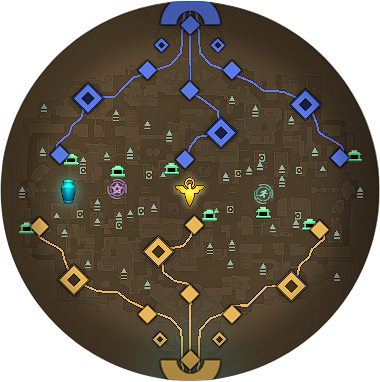
Deadlock Map At A Glance
| Map layer | What is there | Why it matters |
|---|---|---|
| Three lanes | York/Yellow, Broadway/Blue, and Park/Green | Trooper waves, lane shops, ziplines, and the main route through enemy structures |
| Lane structures | Guardian, Walker, Base Guardians, Shrines, then the Patron | Destroying structures opens the map, advances waves, and creates the path to victory |
| Jungle and interiors | Neutral camps, crates, Golden Statues, ropes, tunnels, and side paths | Extra economy and faster rotations, with the risk of losing lane pressure or unsecured souls |
| Side objectives | Soul Urn and Unstable Rift | Team economy, permanent buffs, catch-up pressure, and empowered Rift Troopers |
| Center objective | Mid-Boss and Rejuvenator credits | A powerful fight and siege advantage that can also be stolen after the boss dies |
| Travel network | Lane ziplines and horizontal teleporters | Fast returns, cross-map rotations, split-push pressure, and escape routes |
The Three Deadlock Lanes
York: Yellow Lane
York is the Yellow side lane. Like Green, it is a common side-objective lane because the Soul Urn and Unstable Rift use the outer edges and bridges of the map. Side-lane pressure matters before those objectives appear: a pushed wave forces somebody to answer while your team moves toward the contest.
Broadway: Blue Lane
Broadway is the central Blue lane and the most direct route toward the underground Mid-Boss entrances. That does not mean every Mid-Boss attempt should begin from Blue. The safer setup is to push multiple lanes, remove enemy vision through movement and positioning, and enter only when the other team has a real cost for checking the pit.
Park/Greenwich: Green Lane
Park is the Green side lane, also called Greenwich in current map documentation. It mirrors Yellow’s importance for Urn routes and Rift contests. The useful call is the color, not the lore label: teammates understand “push Green” faster than a debate about which location name the current build displays.
Deadlock used four lanes in an older map. Current guides that still teach four-lane assignments or a Purple lane are describing an obsolete layout. Our Deadlock beginner guide covers the present 6v6 starting structure and how solo and duo lane assignments affect early soul sharing.
Structure Order And The Win Condition
- Guardian: the first major defensive structure in each lane.
- Walker: the next, tougher structure deeper in enemy territory.
- Base Guardians: the final lane defenses at the entrance to the base.
- Shrines: two base objectives that must fall before the Patron can be finished.
- Patron: the enemy team’s main objective, fought through its current phases to end the match.
This order explains why one won fight is not automatically a won game. If no lane is pushed, the team spends the enemy death timers walking and clearing waves. If two lanes are already advanced, the same fight can become a Walker, Shrines, or the Patron. Map preparation converts combat into objectives.
Soul Urn: The Moving Side Objective
The Soul Urn is again its own delivery objective. It first appears at the ten-minute mark and alternates between the Yellow and Green sides on later cycles. A player picks it up with a melee attack and carries it to the opposite side of the map.
The carrier cannot use ziplines or teleporters. Enemy melee hits, stuns, and death can force the Urn to drop, and its value starts decaying when a delivery takes too long. A successful run rewards the courier with souls and permanent Golden Statue buffs. The exact bounty scales with game time and comeback rules, so the decision is about more than the number shown at one minute.
How To Set Up An Urn Run
- Push at least the departure-side lane before committing the carrier.
- Move one teammate ahead of the Urn to check corners and likely interception routes.
- Keep another lane active so the enemy cannot send all six players without losing pressure.
- Do not give the Urn to the only hero who can safely start or disengage the next fight.
- If the route collapses, protect the dropped Urn before chasing a low-health enemy through the map.
Unstable Rift: The Current King-Of-The-Hill Fight
Valve’s June 30, 2026 update rethemed King of the Hill as the Unstable Rift and removed the requirement to deliver an Urn before it starts. The first Rift becomes contestable around the 10-to-12-minute window, with later appearances varying around a seven-minute interval. An in-world preview reveals the side before the global announcement, rewarding players who are already reading the map.
Both teams can build capture progress, but the Rift cannot be claimed while both teams occupy the point. Players in the zone are revealed on the minimap. The winning team receives shared souls and a wave of stronger Rift Troopers in that lane; comeback modifiers can improve the trailing team’s contest and reward.
How To Win A Rift Without Arriving Late
- Notice the early visual cue and identify whether Yellow or Green needs to be pushed.
- Spend or finish a nearby camp before the public timer, not during the final approach.
- Enter from more than one angle so one control ability cannot stop the whole team.
- Keep one eye on the opposite side lane. A split pusher can make a long contest expensive.
- After winning, escort the Rift Troopers or use their pressure to take something elsewhere.
Mid-Boss And Rejuvenator Credits
The Mid-Boss lives in the central underground pit. It has a regenerating shield and can only be damaged properly by players committed inside the arena. When its health reaches the current announcement threshold, both teams receive a warning, which makes slow attempts easy to contest.
Killing the boss is only the first half. A Rejuvenator crystal descends into the pit and can be claimed with heavy melee attacks. The current system can grant multiple team credits, and either team can steal the crystal even if the other team dealt the killing blow. Rejuvenator credits let teammates revive in place after death for a limited period.
Good Mid-Boss Conditions
- One or more enemy heroes are dead, visible far away, or forced to defend a pushed lane.
- Your team has enough sustained damage to break the shield instead of revealing a slow attempt.
- Key control abilities are available for the Rejuvenator drop, not spent only on the boss.
- Nearby waves are healthy enough that a stolen credit does not immediately become a lost base.
- The team has named who will heavy-melee the crystal and who will zone the entrance.
The most common throw is clustering all six players under the falling crystal. One enemy displacement or area-control ultimate can steal the reward. Put the minimum required number on the heavy-melee claim and use everyone else to control entry lines.
Jungle Camps, Crates, And Unsecured Souls
The spaces between lanes contain neutral camps and breakable resources. Neutral enemies and Sinner’s Sacrifice machines produce unsecured souls. They count toward purchases and progression, but enough unsecured souls can drop in a container when the carrier dies.
That creates a simple risk rule: farm the jungle while your route is protected, then spend or secure the value before taking a low-information fight. The Deadlock items guide explains how to convert that economy into a useful purchase instead of holding souls for a fantasy inventory.
Lane Farm Before Jungle Farm
Trooper waves also move the objective state. Clearing a safe lane wave gives souls and forces the enemy to respond; clearing an isolated camp gives souls but does not pressure a structure. Take the wave first unless the lane is unsafe, the camp completes an immediate purchase, or your team has deliberately assigned somebody else to collect it.
Ziplines, Teleporters, And Rotation Rules
Each lane’s zipline connects the base to the current friendly portion of that lane. As a wave advances, the usable line reflects how far the team controls the route. Ziplines are best for returning to an active lane; they are dangerous when enemies can knock you off or predict the exact arrival point.
Teleporters move players horizontally across the map. They are valuable for switching side lanes, responding to a split push, or escaping a route that would be obvious on foot. Before entering one, ask what the destination looks like on the minimap. Fast travel into missing enemies is only a faster mistake.
Early, Mid, And Late Map Priorities
| Phase | Primary map job | Common mistake |
|---|---|---|
| Early game | Collect lane souls, deny orbs, protect health, and avoid donating structure damage | Roaming before a wave is handled and returning poorer than the lane opponent |
| First rotations | Push a wave, buy, then move through a short route for a numbers advantage | Walking through the river of the map with no destination or timing |
| Objective game | Prepare Yellow/Green for Urn or Rift and keep Blue pressure for Mid-Boss access | Reacting only after the global announcement |
| Siege game | Advance multiple lanes, use Rejuvenator or a pick to take structures, then reset | Chasing into the enemy respawn while side waves retreat |
| Late game | Keep waves outside your base, carry detection/control answers, and trade objectives deliberately | Farming alone with enough unsecured souls to become the enemy’s comeback package |
A Simple Map Decision Loop
- Read: Which lanes are moving toward you? Which enemies are visible?
- Clear: Take the nearest safe wave that would otherwise damage a structure.
- Spend: Convert souls before the next contest when a purchase changes the fight.
- Move: Rotate through the shortest route that keeps an exit available.
- Take: Claim a structure, camp, Urn, Rift, Mid-Boss, or enemy hero because the map created the opening.
- Reset: Leave before respawns and missing enemies turn the gain into a trade.
Use the Deadlock hero roles and playstyles guide to decide which teammate should clear, initiate, escort, or hold the next angle. A map plan works better when every hero is not trying to do the same job.
Deadlock Map FAQ
How many lanes does Deadlock have?
Current Standard matches use three lanes: Yellow/York, Blue/Broadway, and Green/Park or Greenwich. Older four-lane and Purple-lane guides are outdated.
What is the objective of Deadlock?
Push through Guardians, Walkers, Base Guardians, and Shrines, then defeat the enemy Patron. Souls, Urn, Rift, Mid-Boss, and jungle camps help create the power or map pressure needed to reach that goal.
Is the Unstable Rift the Soul Urn?
No. Valve separated them on June 30, 2026. The Soul Urn is a delivery objective; the Unstable Rift is a timed King-of-the-Hill capture point.
Where is the Mid-Boss?
It is underground in the center of the map, with entrances around the Blue-lane middle. Its minimap icon and the Tab scoreboard help track whether it is available.
What do Rejuvenator credits do?
They let team members revive in place after dying while the temporary buff is active. The crystal appears after Mid-Boss dies and must be claimed with heavy melee attacks.
Should I clear a lane or take a jungle camp?
Clear the safe lane wave first in most situations because it provides economy and changes structure pressure. Take the camp when the lane is unsafe, somebody else owns the wave, or the camp finishes a useful timing.
The Short Version
Deadlock’s map is three lanes wrapped around a shared economy and objective network. Push waves before rotating, prepare the correct side before Urn or Rift, treat Mid-Boss as a crystal-control fight rather than only a damage check, and spend unsecured souls before risking them. The best map play begins one wave before the objective timer.
Source note: Checked July 21, 2026 against Valve’s June 30 update, the official Old Gods, New Blood overview, and the community-maintained Deadlock Wiki pages for the Cursed Apple, Soul Urn, Unstable Rift, Mid-Boss, and Souls. Deadlock remains in active development; exact timers, bounties, resistances, and comeback values can change.
Current Soul Urn Rules
For the complete spawn schedule, bounty decay, runner bonuses, drop triggers, route planning, and the June 30 split from Unstable Rift, use the Deadlock Soul Urn guide.
Control the lane before moving: Use the Deadlock Troopers guide for the current four-unit waves, soul orbs, lane states, and Rift Trooper rules.
More Deadlock guides
Move from the fundamentals into heroes, items, builds, and current match data.